Rally Bulls

Rally Bulls — Educational Philosophy

From Financial Literacy to
Financial Capability

Through experiential learning that connects knowledge, inquiry, practice, and reflection.

Introduction — Why Financial Education Must Move Beyond Literacy

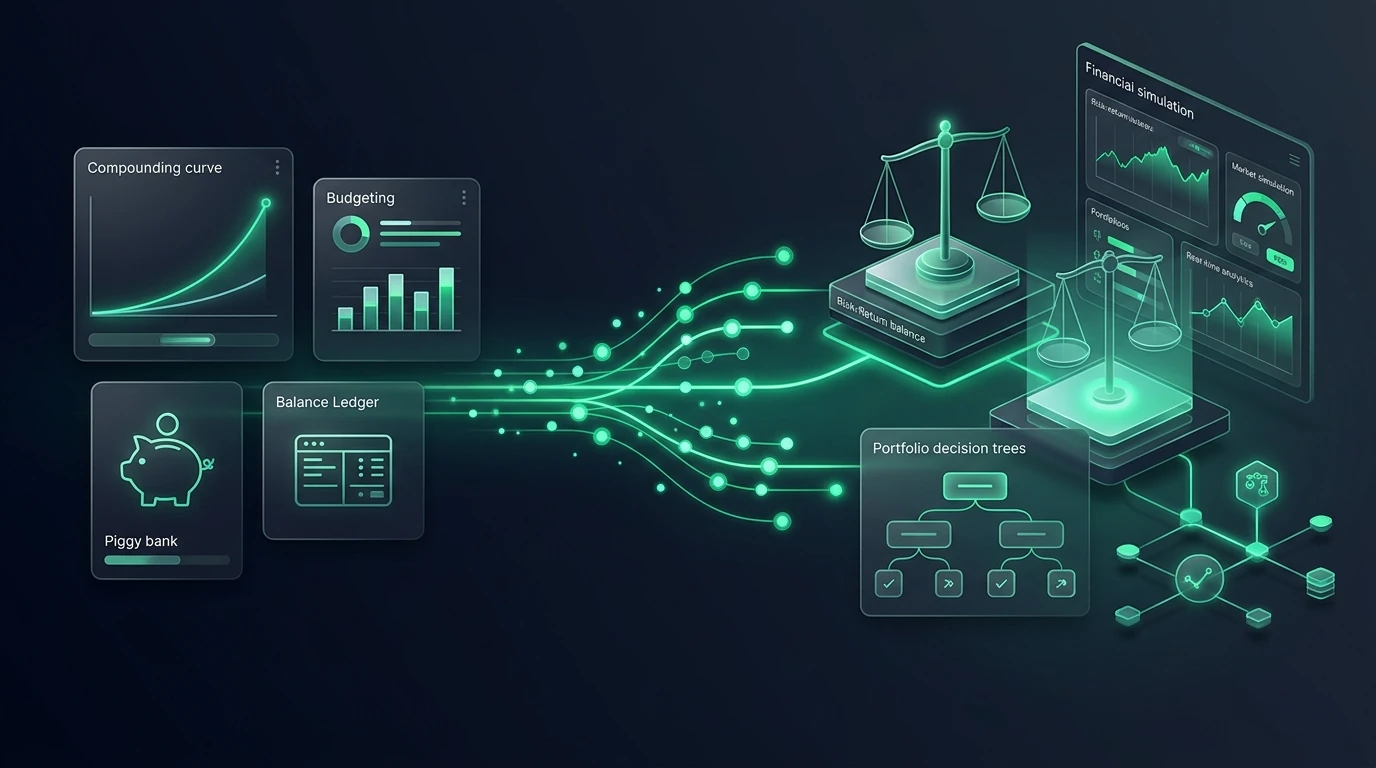
Budgeting, savings, and compounding connected to risk analysis, portfolio decisions, and financial simulation.
From literacy to capability Connecting financial fundamentals with practical judgment and application.

Financial literacy is an essential foundation for navigating modern financial life. Understanding income, budgeting, saving, credit, debt, investing, compounding, diversification, and risk helps people interpret the financial decisions they encounter throughout their lives. These concepts matter because financial decisions extend far beyond the management of money: they influence education, employment, household stability, financial security, and the ability to pursue personal goals.

Yet there is an important distinction between understanding a financial concept and knowing how to apply it. A learner may recognize the importance of saving without knowing how to evaluate competing financial priorities. Someone may understand compound interest without recognizing its implications for debt or long-term savings. A student may understand diversification in theory but struggle to explain how portfolio concentration affects financial risk. Financial literacy provides essential knowledge; applying that knowledge requires interpreting information, evaluating alternatives, recognizing uncertainty, exercising judgment, and reflecting on decisions.

These abilities contribute to what financial education researchers describe as financial capability. Financial capability is broader than factual knowledge alone. The Consumer Financial Protection Bureau's (CFPB) current educator resources identify financial knowledge and decision-making skills, financial habits and norms, and executive function as important developmental building blocks. OECD research also considers financial behavior, attitudes, inclusion, and well-being alongside knowledge (CFPB, updated 2024; OECD, 2023). Education can help learners develop reasoning, habits, and decision-making skills; capability in its broader sense also depends on circumstances, access to appropriate financial resources, and experiences beyond an educational platform.

Financial literacy establishes a foundation. Financial capability develops through the interaction of knowledge, judgment, experience, opportunity, and responsible action. This understanding shaped the educational philosophy behind Rally Bulls. The platform was built on the belief that meaningful financial education should extend beyond delivering information. Learners benefit from opportunities to investigate unfamiliar concepts, evaluate situations, test hypothetical decisions, observe outcomes, receive feedback, and progressively strengthen their understanding.

The objective is not simply to make financial education more engaging or technologically sophisticated. It is to make concepts tangible through thoughtful application. This philosophy draws on experiential learning, active inquiry, formative assessment, and reflection. The U.S. Department of Education's 2024 National Educational Technology Plan emphasizes active uses of technology for analyzing, creating, and problem-solving; the OECD's 2024 student financial literacy assessment likewise examines the ability to apply financial knowledge in practical situations (U.S. Department of Education, 2024; OECD, 2024). These sources inform the educational rationale, but do not establish results for Rally Bulls.

Rally Bulls brings these ideas together through an integrated financial learning ecosystem connecting structured curriculum, artificial intelligence, investment research, market simulation, interactive games, social participation, rewards, and educational progression. Each component serves a distinct educational purpose. Their greater significance lies in how they can connect knowledge with inquiry, experience, feedback, and reflection.

The platform does not presume that technology alone creates financial capability. Nor does simulated success, course completion, or frequent engagement independently demonstrate responsible real-world financial decision-making. Instead, Rally Bulls is designed to support the development of important financial knowledge and skills while recognizing the need for meaningful assessment, educational oversight, and continued evaluation.

Central Belief

People learn financial concepts through education, but develop the abilities that support financial capability through opportunities for application, feedback, reflection, and experience.


The Six Educational Principles Behind Rally Bulls

The Rally Bulls educational philosophy is organized around six interconnected principles. Together, they explain how foundational understanding can progress toward practical application, why inquiry and reflection matter, and how technology and engagement should support responsible financial education. They provide the framework for the learning ecosystem.

Six learning nodes connected around a central hub, illustrating the interconnected educational principles.
Six connected principles A shared framework for knowledge, application, inquiry, reflection, engagement, and responsibility.
Principle One

Foundational Knowledge

Meaningful financial learning begins with foundational knowledge. Before learners evaluate complex financial situations, they need to understand the principles shaping everyday financial life: income, expenses, budgeting, saving, borrowing, interest, credit, debt, financial obligations, liquidity, consumer protection, and long-term planning. These fundamentals influence how investing and market risk should be understood.

Learning about investment volatility is more meaningful when learners understand emergency savings, financial obligations, and investment time horizons. Similarly, understanding potential returns requires recognizing uncertainty, liquidity, opportunity costs, and personal priorities. Without this broader context, market education can become disconnected from the circumstances that make financial decisions consequential. Rally Bulls therefore connects personal finance instruction with progressively more sophisticated investing and trading education.

Educational Takeaway

Strong financial reasoning begins with sound knowledge of personal finance and market fundamentals.

Principle Two

Experiential Application

Financial concepts can become more understandable when learners examine how they apply in realistic situations. Reading about diversification establishes a principle; comparing virtual portfolios provides an opportunity to explore different risk exposures. Studying volatility introduces uncertainty; observing a simulated portfolio helps show how changing prices influence value. Evaluating a hypothetical household budget similarly illustrates how income, expenses, debt, and savings priorities interact.

Experiential learning involves more than participation. Its educational value depends on examining what happened, considering why, connecting observations to principles, and applying the resulting understanding in new situations. This distinction is particularly important in markets, where favorable outcomes do not necessarily reflect sound reasoning. Rally Bulls uses simulated experiences to provide opportunities for exploration without exposing learners' personal capital to market losses, not to encourage speculation or promise predictive success.

Educational Takeaway

Thoughtful application connects financial knowledge with decisions, consequences, and risk.

Principle Three

Critical Inquiry

Financial information is widely available, but access to information is not equivalent to understanding it. Learners encounter financial news, market data, economic reports, research, commentary, and competing interpretations. These sources may be informative, but can also be incomplete or difficult to evaluate. Financial understanding requires investigating information critically rather than accepting conclusions at face value.

A thoughtful learner should ask what information means, what evidence supports it, which assumptions are being made, what risks may be overlooked, and what else is needed. These habits apply when comparing borrowing options, evaluating financial products, considering investment alternatives, or assessing competing priorities. The Investment Research Hub, Market News, and Toro AI are intended to make exploration more accessible while supporting informed questioning and independent judgment, not replacing them.

Educational Takeaway

Financial understanding is strengthened through investigation, evidence, comparison, and independent judgment.

Principle Four

Feedback and Reflection

Experience creates opportunities for learning, but understanding requires examining that experience. A virtual portfolio may increase substantially in value because of favorable market conditions or unrecognized risks; another may decline despite a thoughtful decision. In both situations, the educational value lies in evaluating the decision-making process rather than treating the outcome as proof of skill.

Learners benefit from asking which assumptions shaped a decision, which risks were recognized, what changed, and what they would investigate differently. Assessments can reveal misunderstandings, analytics can illustrate exposure, educators can guide discussion, and AI-assisted explanations can offer context. The CFPB's updated youth financial education assessment tools emphasize evaluating what young people know, understand, and can do, while helping educators identify learning needs (CFPB, updated 2024). Rally Bulls incorporates assessments, progress tracking, research, analytics, and inquiry to create opportunities for this process.

Educational Takeaway

Learning deepens when experience is accompanied by feedback, reflection, and opportunities to improve.

Principle Five

Purposeful Engagement

Financial subjects may initially seem complicated, intimidating, or disconnected from a learner's interests. Accessible activities, games, social participation, recognition, and progression can encourage engagement with unfamiliar concepts. Motivation matters because learning requires sustained attention and opportunities to revisit important material.

Engagement is not the same as educational achievement. Winning a market-direction game does not establish competence; a favorable fantasy league ranking need not demonstrate sound analysis; accumulating rewards does not prove mastery. These experiences become more educationally valuable when they lead to investigation, coursework, reflection, and understanding. Rally Bulls treats competition and rewards as elements within a broader learning environment, not as independent measures of financial capability.

Educational Takeaway

Motivation supports learning when participation reinforces knowledge, inquiry, practice, and progression.

Principle Six

Responsible Education

Technology can expand access to information, support diverse learning approaches, and create experiences difficult to reproduce through static instruction. But it does not automatically produce understanding. AI can provide helpful explanations while also generating errors; simulation can support practice without reproducing the consequences of real-money decisions; competition can motivate participation while encouraging excessive focus on short-term results.

Rally Bulls places educational objectives ahead of technological novelty. AI should strengthen independent reasoning; simulation should reinforce risk awareness; engagement should support learning; and assessment should focus on understanding. In institutional settings, educators remain central to instruction, oversight, and interpretation. Age appropriateness, privacy, accessibility, transparency, and learner safety are essential considerations in evaluating educational technology.

Educational Takeaway

Responsible technology strengthens human judgment and operates within appropriate educational boundaries.

The six principles—Foundational Knowledge, Experiential Application, Critical Inquiry, Feedback and Reflection, Purposeful Engagement, and Responsible Education—are not six separate products. Together they establish the responsibilities that guide the entire Rally Bulls ecosystem.

The Rally Bulls Learning Ecosystem

Connecting Knowledge to Experience

Why Integration Matters

Financial education is frequently delivered through separate experiences: a course introduces concepts, a research tool provides information, a simulator allows practice, a game encourages participation, and an assessment measures performance. Each can be valuable independently. A greater educational opportunity emerges when learners can move between them and connect what they study with what they investigate, practice, question, and evaluate.

This belief shaped Rally Bulls. Rather than treating curriculum, AI, research, simulation, and gamification as unrelated offerings, the platform brings these capabilities into a connected environment. A student encountering an unfamiliar concept in a game may investigate it through Toro, study its underlying principle in a course, examine related information in the Research Hub, and explore implications through Paper Trading. Another learner may begin with personal finance instruction; an educator may select activities around a particular learning objective. These pathways need not be identical. Their common purpose is to connect knowledge, inquiry, application, feedback, and reflection.

The Rally Bulls Learning Loop

The ecosystem expresses that progression through an engagement and learning framework:

  1. Play
  2. Research
  3. Analyze
  4. Practice
  5. Compete
  6. Earn
  7. Redeem
  8. Level Up
Feedback + reflection connect every stage

Play can spark a question; research provides information and context; analysis invites interpretation and comparison; practice enables simulated application; competition introduces social participation; rewards recognize eligible engagement; and progression encourages further learning. The Loop is not a mandatory sequence or a claim that competition or rewards are necessary for understanding. Learners may begin with courses, inquiry, portfolios, or games—and move repeatedly between them as questions emerge.

Feedback and reflection belong throughout the Learning Loop, not only at its conclusion. A learner may revisit instruction after an unexpected outcome or return to research when a new assumption is challenged. This iterative relationship is more important than any single interaction.

Three Complementary Frameworks, One Philosophy

The six educational principles explain why Rally Bulls approaches learning this way. The four learning pillars—Learn, Explore, Practice, and Engage—explain how the platform supports those principles. The Learning Loop illustrates how learners move among connected experiences. They are complementary perspectives on one educational design, not competing models.

One philosophy / Three complementary views
  1. Why

    Six Educational Principles

    The learning beliefs behind Rally Bulls.

  2. How

    Four Learning Pillars

    How the ecosystem puts them into practice.

  3. Experience

    The Learning Loop

    How learners move among connected activities.

  • Knowledge
  • Application
  • Inquiry
  • Reflection
  • Engagement
  • Responsibility

Putting the Philosophy Into Practice — Four Connected Learning Pillars

The six educational principles establish Rally Bulls' educational reasoning. The four pillars show how those principles appear across the platform's capabilities. Each serves a distinct purpose; their integration creates opportunities for broader financial understanding.

Pillar I / Learn

Establishing Financial Foundations

15+
Personal finance courses
4
Investing & trading levels
80%
Required assessment score for applicable material

Structured education provides the knowledge upon which meaningful application depends. Without foundational understanding, participation can become an exercise in making choices without appreciating their implications. Rally Bulls Institute connects personal finance education with progressive investing and trading instruction.

Its personal finance curriculum includes 15+ courses addressing subjects relevant to everyday life, including spending, cash flow, paychecks and taxes, saving, credit, debt, banking, consumer protection, insurance, investing, entrepreneurship, and money and mental health. These topics help learners interpret the financial decisions that shape personal obligations and long-term goals. The trading and investing curriculum progresses through four levels—Foundational, Intermediate, Advanced, and Expert—providing a framework for advancing from introductory concepts toward market analysis, risk management, portfolio construction, and strategies.

Investing & trading progression
  1. Level 01Foundational
  2. Level 02Intermediate
  3. Level 03Advanced
  4. Level 04Expert

Microlearning, Assessment, and Progression

The Institute incorporates microlearning, quizzes, progress tracking, certification opportunities, and a required 80% assessment score to advance through applicable material. Short lessons help organize complicated topics, while assessments encourage learners to check comprehension and revisit ideas. Certifications recognize designated educational milestones, and Rally Coins provide additional incentives for eligible learning activities.

These mechanisms support educational progression, but their meaning must be interpreted carefully. An 80% score demonstrates performance against a defined assessment; it does not independently establish comprehensive financial capability or guarantee real-world application. The Institute's broader role is to establish essential knowledge that can be reinforced through inquiry, simulation, and reflection.

Connecting Personal Finance and Investing

A defining element of the philosophy is that personal finance and market education belong within one framework. Before learners explore market volatility, they benefit from understanding emergency savings, borrowing costs, obligations, liquidity, and financial goals. Investing concepts become more meaningful when connected to the financial realities people actually face.

Pillar II / Explore

Developing Research and Critical Thinking

Learners encounter complex and changing financial information: company reports, asset prices, economic indicators, financial news, market sentiment, and conflicting interpretations. The challenge is not simply access; it is learning to evaluate information. Rally Bulls connects Toro AI, the Investment Research Hub, and Market News so learners can investigate questions and develop analytical habits.

Toro AI — Intelligence That Supports Understanding

Toro is Rally Bulls' AI-powered educational co-pilot. Its purpose extends beyond answering isolated questions to helping learners investigate concepts, information, hypothetical scenarios, and simulated market activity. Toro supports six complementary functions:

Tutor
Explains financial terms and concepts in accessible language.
Researcher
Helps investigate assets, sectors, and market developments.
Analyst
Assists with historical performance, financial information, and market influences.
Strategist
Supports exploration of hypothetical approaches, assumptions, and risk.
Trading Co-Pilot
Offers educational context around simulated portfolios and decisions.
Paraeducator
Supports guided learning activities alongside educators.

These functions share a principle: AI should help learners think more clearly, not replace their responsibility to think. A learner investigating volatility can ask Toro to clarify terminology, consider potential influences, compare interpretations, and suggest questions for additional research. The learner can connect those explanations to course principles and supporting evidence.

Toro may also support hypothetical forecasts and scenario exploration involving different assumptions or market conditions. AI-generated research, analysis, and projections can be incomplete or incorrect; scenarios are not dependable predictions or personalized recommendations. Their educational value is in examining assumptions and uncertainty, not creating unwarranted confidence.

Investment Research Hub — Building Analytical Habits

The Research Hub supports investigation of companies, sectors, assets, and financial developments using fundamental, technical, sentiment, and market-context perspectives. A learner might examine a company's business, financial metrics, historical behavior, sector conditions, and relevant news. These sources may support different interpretations, making comparison essential.

A price movement does not explain itself; favorable earnings do not eliminate risk; and optimistic market sentiment does not establish appropriate valuation. The Research Hub and Toro can help learners recognize such distinctions. The objective is disciplined inquiry and evidence-based reasoning—not automatic trading instructions or stock tips.

Market News — Connecting Concepts to Current Events

Inflation reports, interest-rate decisions, earnings, technological developments, and geopolitical events can connect classroom ideas to observable conditions. Rally Bulls' financial news experience provides frequently refreshed information intended to support this contextual learning.

A lesson on inflation can be revisited after an economic report; a discussion of company fundamentals can be extended after earnings; changes in a virtual portfolio can prompt investigation of relevant market conditions. But timely news should not create pressure to act. Headlines may be incomplete and immediate reactions may be misleading. Rally Bulls treats current developments as opportunities for investigation rather than speculation.

Pillar III / Practice

Applying Knowledge Without Real-Money Exposure

Traditional instruction explains diversification, volatility, allocation, and risk management. Simulation adds an opportunity to examine their interaction under changing conditions. Rally Bulls Paper Trading provides a virtual environment in which learners can research assets, construct portfolios, make simulated decisions, observe market developments, and review outcomes with virtual funds and market data.

The simulator supports stocks, exchange-traded funds, and cryptocurrencies, subject to current platform availability. Learners can compare different asset categories, adjust holdings, and manage multiple portfolios. A diversified portfolio can be examined alongside one concentrated in a particular investment theme. As markets change, differences in simulated performance can be investigated using holdings, virtual balances, cost basis, allocation, market value, price changes, and gains or losses.

AI-Created Portfolios as Educational Examples

Rally Bulls also describes a library of Toro-created portfolios representing different asset categories, themes, and approaches. Such examples can provide starting points for comparing diversification, concentration, allocation, and hypothetical strategy design. Their educational value lies in investigation and comparison. AI-created portfolio examples are not personalized investment recommendations, nor do they imply predictive accuracy or future success.

Practice, Feedback, and Reflection

The significance of Paper Trading extends beyond making transactions. A simulated portfolio may gain or lose value, but an educational assessment should consider why decisions were made, which assumptions informed them, what risks were recognized, and how new information changes the analysis. A favorable outcome may reflect analysis, favorable conditions, or chance; a disappointing result does not automatically prove bad reasoning.

Simulation has important limitations. Virtual trading cannot fully reproduce emotional pressure, execution conditions, liquidity constraints, financial obligations, or the real consequences of investing personal capital. Strong simulated performance should not be interpreted as a guarantee of real-world results. Nor can market simulation replace personal finance education on saving, debt, consumer decisions, and planning.

Pillar IV / Engage

Reinforcing Learning Through Participation

Sustained learning benefits from opportunities to revisit concepts, encounter questions, and recognize progress. Rally Bulls brings together Daily Games, Fantasy Trading Leagues, Rally Coins, and the RB Shop to support participation and motivation. These experiences complement curriculum, inquiry, and simulation; they are not substitutes for them.

Daily Games — Repetition With Purpose

Daily Games provide short interactive experiences such as financial quizzes, directional challenges, and other formats across stocks, ETFs, cryptocurrencies, and sectors. An unfamiliar concept encountered during a game might lead to Toro, Research Hub exploration, or coursework. This connection matters because correct market predictions and game wins do not independently demonstrate analytical competence. A game contributes more meaningfully when it prompts explanation, investigation, and reflection.

Fantasy Trading Leagues — Learning Socially

Fantasy Trading Leagues bring a social and competitive format inspired by fantasy sports to simulated market participation. Public and private leagues and supported competitions invite users to compare decisions, investigate market information, and discuss outcomes. Competition may encourage curiosity, but short-term rankings may reflect conditions, uncertainty, or concentration in risk. Winning a league should never be equated with financial mastery.

With appropriate connections to coursework, research, Toro, and Paper Trading, fantasy participation can create opportunities for discussion, comparison, and collaborative reflection.

Rally Coins and the RB Shop — Recognizing Progress

Eligible educational and participatory activities can earn Rally Coins, which may be redeemed through the RB Shop for available platform benefits and external rewards, subject to eligibility and applicable terms. Coin earning can involve coursework, games, and competition-related achievements.

Completing an assessment, participating in a game, and performing well in a competition are distinct accomplishments; they are not interchangeable measures of competence. For schools and other institutions—especially when real-world rewards are available—age appropriateness, policies, educational objectives, and oversight should be considered. Incentives should support constructive learning rather than encourage impulsive decisions or excessive focus on short-term gains.

From Concept to Capability — Experiential Learning in Action

The educational philosophy is clearer when viewed through specific learning experiences. The following illustrative pathways show how instruction, inquiry, hypothetical application, and reflection can reinforce one another. They are examples of educational use, not claims about independently measured outcomes.

Example One

Understanding Diversification Through Experience

Consider a learner studying diversification. The definition—spreading investments among different assets—provides a starting point, but does not fully explain the relationship between portfolio concentration and risk. Coursework can introduce asset categories, volatility, and the importance of time horizon and financial obligations. Toro can then help the learner examine how different assets or sectors may share underlying exposures, while the Investment Research Hub provides additional company and market context.

Using Paper Trading, the learner constructs two virtual portfolios: one more broadly diversified, another concentrated in a narrower investment theme. As prices change, the learner compares performance, volatility, and exposure, noting that either portfolio may outperform over a particular period. No single outcome establishes which portfolio is universally preferable.

The learner revisits the original assumptions: Did the holdings actually reduce concentration? Which risks were overlooked? What would additional data reveal? Coursework, Toro, research, an educator-led discussion, or a later game can provide further opportunities to reflect. The objective is not to predict market winners, but to understand diversification, evidence, uncertainty, and risk.

Example Two

Evaluating Everyday Financial Priorities

Experiential learning need not begin with investing. Consider a student exploring credit card debt and emergency savings. The learner understands that saving is important and borrowing involves interest, but practical financial decisions may involve competing priorities. A hypothetical household has limited monthly income, an outstanding credit card balance, and little emergency savings.

Personal finance coursework introduces income, budgeting, interest, credit, debt, and saving. An educator or guided activity presents hypothetical amounts and asks the student to explore alternative uses of available funds. Toro-supported explanations and calculations may help clarify annual percentage rates, borrowing costs, repayment considerations, and the purpose of liquidity. This example does not require or imply a dedicated Rally Bulls budgeting simulator.

The learner compares tradeoffs without being given a universal answer: how might a payment reduce interest costs, and how might reduced savings affect exposure to an emergency? The exercise ends with a short explanation or assessment of the reasoning, uncertainties, and information still needed for a real financial decision. This provides evidence of developing understanding, not proof of comprehensive personal financial management.

One Philosophy, Multiple Pathways

The diversification example uses simulated markets to explore investing principles. The personal finance example uses instruction, inquiry, hypothetical analysis, and reflection to examine everyday priorities. Not every learner needs every feature for every concept. Experiences should be selected and connected according to the learning objective.

Responsible AI, Educator Leadership, and Educational Guardrails

Financial education involves responsibilities beyond delivering instructional content. Learners may encounter consequential financial information, uncertain markets, AI-generated analysis, and competitive activities involving simulated performance. Responsible design requires clear boundaries around these experiences.

Our institutional commitment

Teacher-led.AI-supported.Student-centered.

Explore the guidance

Financial Education Is Not Personalized Investment Advice

Teaching financial markets is different from instructing someone to make a specific real-money investment. Learners can examine diversification, risk management, technical or fundamental analysis, portfolio construction, and hypothetical strategies without receiving recommendations to buy or sell securities. Rally Bulls is designed to support understanding through instruction, research, AI-assisted explanations, and simulation.

Market forecasts, AI-created portfolios, research materials, and hypothetical scenarios must be interpreted in that educational context. They cannot guarantee outcomes or eliminate uncertainty. Historical, hypothetical, and simulated performance does not reliably establish future results. The objective is to understand financial reasoning and risk, not promise success or encourage speculation.

AI Should Complement Human Judgment

AI can make complicated subjects more approachable by explaining terms, organizing information, introducing possible interpretations, and supporting hypothetical investigation. It can also produce outdated, incomplete, or incorrect statements. Learners should verify important information, examine underlying evidence, and recognize uncertainty.

Toro should be understood as educational support, not an independent authority for financial decisions. UNESCO's 2024 AI competency frameworks for teachers and students emphasize human agency, ethical use, critical judgment, and responsible participation in AI-supported learning (UNESCO, 2024). The proper role of AI is to strengthen human reasoning, not displace it.

Educators Remain Central to Institutional Learning

In schools and educator-led settings, teachers establish objectives, interpret student needs, guide discussion, provide feedback, evaluate understanding, and exercise professional judgment. Toro's tutor and paraeducator functions are intended to complement, not replace, those responsibilities. Educators can connect financial simulations to curriculum objectives, help learners interpret outcomes, and distinguish engaging activity from evidence of understanding.

Rally Bulls expresses this institutional commitment as Teacher-led. AI-supported. Student-centered. Where a learner studies independently, the underlying commitment remains: technology should support the learner's judgment and responsibility rather than replacing them.

Safeguards Are Part of Educational Quality

Institutional adoption requires attention to age appropriateness, privacy, student information, accessibility, transparency, and applicable educational requirements. These matters must be evaluated against the actual product, deployment configuration, learners, and institutional obligations. The availability of educational features alone does not establish that a particular implementation meets a school's requirements.

Similar care is needed with competition and rewards. Although simulation avoids direct use of personal trading capital, it does not eliminate behavioral concerns. Competitive experiences may affect risk perceptions, and real-world rewards require scrutiny of eligibility, learner age, institutional policies, and educational purpose. Learning, human judgment, oversight, and learner well-being must remain ahead of novelty or short-term performance.

Section 06

Measuring What Matters — From Participation to Learning Outcomes

A digital platform can measure course completion, assessment scores, game activity, simulated transactions, virtual portfolio results, and rewards. These indicators offer useful information about participation, but they represent different things. Engagement, demonstrated knowledge, applied understanding, and broader financial capability should not be treated as equivalent.

  • Engagement

    Participation and opportunities to revisit concepts.

  • Demonstrated Knowledge

    Performance on defined questions and assessments.

  • Applied Understanding

    Reasoning in explanations, scenarios, and reflection.

  • Broader Financial Capability

    Requires evidence across situations and circumstances.

Engagement Is a Starting Point

Participation matters because learners need opportunities to encounter and revisit concepts. Coursework may reinforce knowledge; Toro questions may clarify unfamiliar topics; simulations may illustrate risk. But educational value depends on what learners can explain, evaluate, and apply. Rally Bulls' quizzes, assessment thresholds, progress tracking, certification opportunities, and experiential activities support different forms of progression.

An assessment score reflects performance on particular questions. A written explanation may reveal reasoning. A scenario-based exercise can show how a concept is applied. Reflection on a simulated decision can demonstrate awareness of uncertainty. These measures can contribute to an educational picture, but should not be inflated into claims of comprehensive capability.

Meaningful Educational Objectives

The broader objectives concern learners' ability to:

  • Explain Concepts

    Explain core financial concepts and their practical significance.

  • Recognize Risk

    Recognize financial risk, uncertainty, and important tradeoffs.

  • Investigate Information

    Investigate financial information and evaluate supporting evidence.

  • Compare Alternatives

    Compare alternatives using appropriate financial principles.

  • Connect Choices

    Connect choices to circumstances, obligations, and objectives.

  • Reflect on Reasoning

    Reflect on the reasoning behind hypothetical decisions and observed outcomes.

A learner who explains portfolio concentration may demonstrate meaningful understanding even if a concentrated virtual portfolio happens to outperform. Likewise, a student who compares borrowing costs with savings priorities can demonstrate financial reasoning without market participation.

Building Evidence of Learning

The broader challenge is whether learners strengthen their understanding and can apply concepts across situations. Platform assessments and activity data provide useful but incomplete information. Educational pilots, before-and-after assessments, scenario-based evaluations, educator feedback, classroom observation, and longer-term studies can help determine which learning experiences are effective. U.S. Department of Education evaluation guidance also emphasizes documenting how an intervention is implemented and the conditions under which its effects are studied (Institute of Education Sciences, 2023).

  • Educational pilots
  • Before-and-after assessments
  • Scenario-based evaluations
  • Educator feedback
  • Classroom observation
  • Longer-term studies

Evaluation should distinguish knowledge gains from real-world financial behaviors and outcomes, which depend on circumstances beyond the platform. Rally Bulls' educational design states what the platform aims to support; it is not, by itself, independent proof that those outcomes have been achieved. Educational innovation should be accountable to appropriate evidence.

Section 07

Why Integration Matters — A Broader Vision for Financial Education

Financial education operates at the intersection of knowledge, experience, judgment, and personal circumstances. Learners benefit from structured instruction, opportunities to investigate information, experiences through which to apply concepts, and feedback that helps them interpret results. Games and rewards can support motivation; AI can expand access to explanation; educators can connect activities to learning objectives and provide judgment and oversight.

Rally Bulls brings these experiences together through an intentionally connected model. A question arising in a game may lead to research; research may reveal a gap that coursework can address; a course may introduce a principle that becomes more tangible through simulation; an unexpected outcome may prompt new inquiry. The value lies not simply in having several tools available, but in the educational connections among them.

An illustrative learning connection
  1. A question
  2. Research
  3. Coursework
  4. Simulation
  5. New inquiry

Supporting Different Learners and Educational Settings

Financial capability develops over time. Younger learners may begin with saving, spending, and needs versus wants. Older students may explore credit, debt, investing, planning, and market behavior. Adults may revisit financial concepts as their obligations and goals change. The same educational principles may apply across contexts, though appropriate material, safeguards, assessments, and instructional approaches will differ.

  • For Individuals

    For individuals, a connected environment may support self-directed exploration.

  • For Educators

    For educators, it can provide resources for connecting formal lessons to real-world questions and hypothetical activities.

  • For Institutions

    For institutions, the framework offers a rationale for bringing curriculum, technology, engagement, and assessment together while preserving professional oversight.

These possible benefits should be evaluated in practice: connection is valuable when it serves a learning objective, not merely because features share a platform.

A Responsible Vision for Innovation

Artificial intelligence, market simulation, research tools, and interactive games can create opportunities that static instruction alone may not provide. They can make abstract concepts approachable, encourage curiosity, and connect learning with changing information. But educational quality depends on purpose, responsible implementation, and evidence of learning—not novelty.

Section 08

Conclusion — Building Financial Capability Through Knowledge and Experience

Financial literacy provides an essential foundation for navigating financial decisions. Understanding budgeting, saving, credit, debt, investing, and financial markets helps learners interpret a complex financial environment. But meaningful financial education extends beyond familiarity with definitions and principles. Learners also benefit from opportunities to investigate information, compare alternatives, recognize uncertainty, make hypothetical decisions, and reflect on outcomes.

Rally Bulls was built around that educational belief. Its courses establish financial foundations; Toro supports explanation and inquiry; the Research Hub and Market News provide context; Paper Trading creates opportunities for simulated application; Daily Games and Fantasy Trading Leagues encourage participation; and rewards and assessment support motivation and educational progression. The significance of these capabilities lies in how they can reinforce one another.

The philosophy does not claim that technology independently creates financial capability. Educators remain important; AI requires oversight; simulations have limitations; engagement is not learning; and educational effectiveness must be evaluated rather than assumed. The opportunity lies in connecting these experiences through a coherent model that encourages learners to question, investigate, apply, and reflect.

Closing Thought

The future of financial education is not simply about delivering more information. It is about creating meaningful opportunities to transform information into understanding and understanding into responsible application.

From financial literacy toward financial capability—through structured education, responsible technology, experiential learning, and continuous feedback.

Section 09

Key Takeaway

Rally Bulls believes the knowledge and skills contributing to financial capability develop through the connection of education, experience, critical inquiry, feedback, and reflection. By integrating Toro AI, Courses, Paper Trading, Daily Games, Fantasy Trading Leagues, Investment Research, Market News, and rewards within one ecosystem, Rally Bulls aims to help learners move beyond knowing concepts toward understanding how to apply them responsibly.

The purpose is not to predict markets, guarantee investment results, or claim simulated success establishes real-world competence. It is to support financial understanding, independent judgment, risk awareness, and thoughtful decision-making—before real money is at stake.

Back to contents
Further Reading

Selected Educational References

The following recent U.S. and international sources provide institutional context for Rally Bulls' educational philosophy. They do not imply that these organizations endorse Rally Bulls or have independently validated its educational outcomes.

Opens in a new tab.
  1. Consumer Financial Protection Bureau (updated 2024).

    Assess Development of the Building Blocks of Financial Capability.

    U.S. educator resources for evaluating young people's financial knowledge, decision-making skills, habits, and developmental progress.

    Read CFPB resource
  2. OECD (2024).

    PISA 2022 Results (Volume IV): How Financially Smart Are Students?

    International assessment of students' financial knowledge and ability to apply it in practical situations.

    Read OECD report
  3. OECD (2023).

    OECD/INFE 2023 International Survey of Adult Financial Literacy.

    Global evidence on financial knowledge, behavior, attitudes, inclusion, and well-being.

    Read OECD survey
  4. U.S. Department of Education, Office of Educational Technology (2024).

    A Call to Action for Closing the Digital Access, Design, and Use Divides: 2024 National Educational Technology Plan.

    U.S. guidance on purposeful, active technology use in teaching and learning.

    Read education technology plan
  5. UNESCO (2024).

    AI Competency Framework for Teachers.

    Global framework for ethical, human-centered, and pedagogically responsible AI use by educators.

    Read teachers' AI framework
  6. UNESCO (2024).

    AI Competency Framework for Students.

    Global framework emphasizing critical judgment, responsible AI use, and student agency.

    Read students' AI framework
  7. U.S. Department of Education, Institute of Education Sciences (2023).

    Conducting Implementation Research in Impact Studies of Education Interventions: A Guide for Researchers.

    Evaluation guidance emphasizing implementation, context, and interpretation of impact evidence.

    Read evaluation guide (PDF)

Disclaimer

Educational and Informational Purpose

This document describes Rally Bulls' educational philosophy, learning objectives, and intended educational applications. It is provided for educational and informational purposes only and does not constitute personalized financial, investment, or legal advice. Rally Bulls does not guarantee financial performance, educational outcomes, or improvements in real-world financial behavior.

Simulation and Performance

Paper Trading uses virtual funds and does not reproduce all the risks, emotional pressures, transaction conditions, liquidity considerations, or financial consequences associated with investing personal capital. Historical, hypothetical, and simulated results do not guarantee future outcomes.

AI-Generated Information

Toro AI-generated information, research, market analysis, forecasts, and portfolio examples may contain inaccuracies, incomplete information, or uncertainty and should be independently verified. Educational scenarios and AI-created portfolios do not constitute personalized investment recommendations.

Platform Availability and Institutional Context

Product features, curriculum availability, AI functionality, market data, rewards, and institutional capabilities may vary according to platform, plan, jurisdiction, and implementation. Institutional suitability, age-appropriate safeguards, privacy protections, and relevant educational requirements should be evaluated within the specific deployment context. Actual participation in financial markets involves risk, including possible loss of principal.

© Rally Bulls. All rights reserved. Rally Bulls materials are proprietary and may not be reproduced without permission.

Back to contents